The Artist as Capitalist.
or...the capitalist as artist?

On Monday, January 26th, 2026 from 4-7PM ET, director, writer, teacher and producer Gregory Mosher and Hunter College hosted a forum called “We The People: An Assembly of New York Artists” at Danspace @ St. Marks Church-in-the-Bowery, NY NY. I was honored to be invited on as one of five guest artist moderators. Hundreds came over the course of 3 hours. The only rule of the night was you had to state your artistic issue or need in 60 seconds.
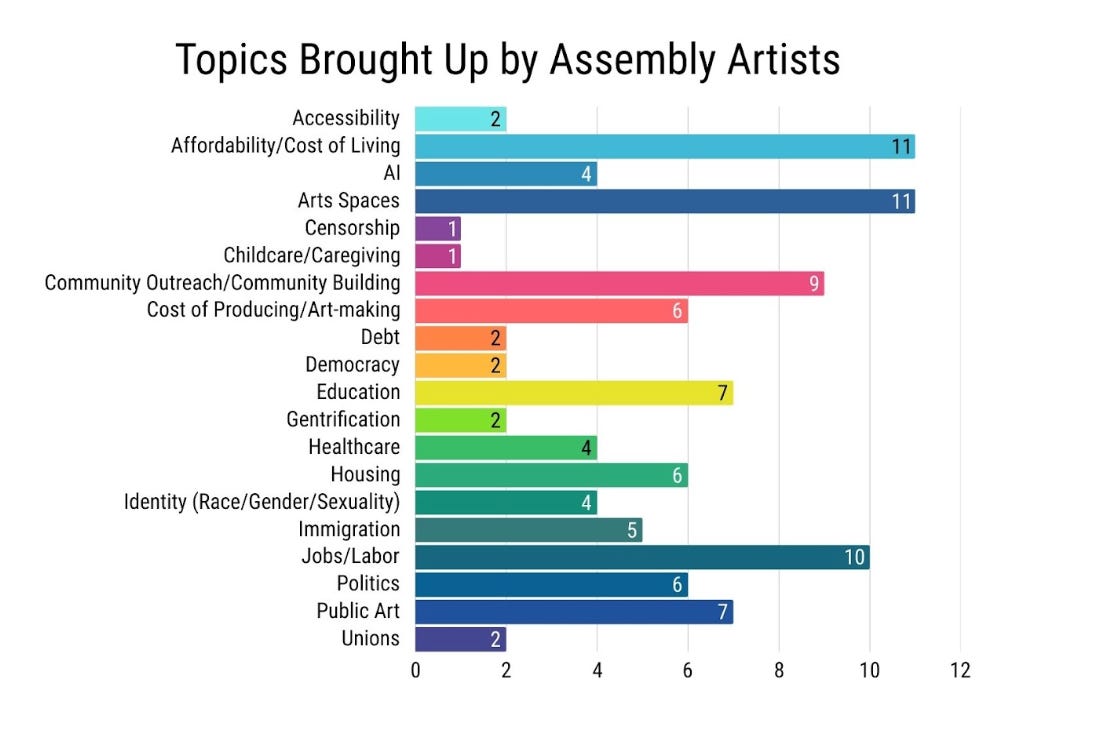
The image above is an aggregation of the issues and needs voiced.
The moment of the night for me was when an artist stood up and said:
“There is no place for the artist in capitalism!”
This statement was understandably met with solidarity and a rousing cheer.
But… is this accurate?
To unpack this massive statement, I am going to ill-advisedly attempt a complete rip-off Oscar Wilde’s 1891 piece, The Critic as Artist.
In The Critic as Artist, Wilde invents two guys, Ernest and Gilbert (Gilbert is basically Oscar’s stand-in), who dialogue about, essentially, who is more important to humanity, the critic or the artist. This piece was actually quite controversial because Wilde’s conclusion is that the critic is more important to humanity than the artist. (Oscar obviously hasn’t been to show-score.com).
Wilde’s narrative in The Critic as Artist isn’t necessarily to arrive at any great catharsis or answer or destination, rather to simply invoke ideas and to overturn old, normalized concepts.
Oscar, forgive me. Here goes nothing.
THE ARTIST AS CAPITALIST
A cheap impression of Oscar Wilde, now with added swearing.
A DIALOGUE.
Persons: Gilbert and Ernest.
Scene: The library of a house in Piccadilly, overlooking the Green Park.
ERNEST: Good day, Gilbert!
GILBERT: And a good day to you, dear Ernest!
ERNEST: Question: Is there a place for the artist in capitalism?
GILBERT: Not exactly.
ERNEST: Well! Sir Lin-Manuel Miranda would disagree with you there, my good man. That gentleman and his 80 million pounds have certainly found a comfy little corner of capitalism in which to lamp.
GILBERT: Well then perhaps that gentleman is not an artist anymore.
ERNEST: Good god man! Are you mad enough to argue that?
GILBERT: I’m mad enough to argue most anything, old boy. Let’s break it down, shall we? What is capitalism? It’s an economic system where certain people own or make things that other certain people choose whether or not to buy. In capitalism, the motivation for literally everything is money. There is nothing else holding capitalism together but profit. So if there is no profit, there is no capitalism and you, the seller, go away. Now: What is an artist? An artist is someone who traffics in expressions of feelings and ideas. The artist’s motivation for everything is, arguably, the desire for expression. So if there is no expression, obviously, there is no artist. So in theory, money doesn’t come into the equation at all.
ERNEST: Obviously it does if you can buy someone’s artistic expression—tickets, paintings, books, streaming services— it goes on and on. Any and all art is for sale for the right price. How dare you say that profit and expression don’t mix?
GILBERT: They certainly can mix. In the same way that 8 year olds and Little League can mix. Once in a while, a third grader inexplicably nukes that ball out of the park. Everyone in the stands goes balmy and the lad is a hero. But don’t expect that to happen again.
ERNEST: So any time an artist makes any money at their art, it’s as lucky as an 8-year-old hitting a home run? That’s not only the most cynical thing I’ve ever heard, but also insulting to artists who churn out hit after hit, like Miranda or… I don’t know, how about…Stephen Sondheim, who you love, and… ah ha! Hugh Jackman!
GILBERT: You’re joking.
ERNEST: Certainly not! You yourself have marveled at the fact that Mr. Jackman can clearly do legitimate theater, musical theater, film of course and let’s not forget that when you saw him in Jez Butterworth’s The River in 2014 in The Circle in The Square you admitted to your husband later that night that you couldn’t focus on the play for more than 5 minutes because you were distracted by Hugh’s spectacular arse.
GILBERT: I never said that.
ERNEST: You did! You went on to say: “I thought movie stars are supposed to be shorter and uglier in real life!”
GILBERT: That’s enough.
ERNEST: “But Hugh Jackman is more breathtaking in real life! And my god that arse—!”
GILBERT: SHUT UP, ERNEST.
ERNEST: Gilbert, your argument has so many holes I could wash lettuce through it. Of course there is a place for artists in capitalism, but because the artist traffics in expression, feelings and ideas, as you say, it’s simply harder to hit a capitalism vein than the average non-artistic widget-seller.
GILBERT: And how might the artist locate that capitalism vein?
ERNEST: By appealing to the masses, resonating with everyone, simultaneously. And it’s a rare vein to hit because no two human beings feel things the same way. How is the artist supposed to appeal to Johnny January-Six and Kelly Harvard at the same time? It feels impossible. But history has shown us of course that some artists have accomplished it.
GILBERT: So the public decides which artists fit into capitalism and which don’t?
ERNEST: I suppose so, yes.
GILBERT: Very well. But if you leave it to the public—- the American public, mind you— to be the ultimate arbiters of what art rises to the top you know what you wind up with?
ERNEST: What?
GILBERT: Friends.
ERNEST: The show? But Friends isn’t art.
GILBERT: But it hits all your qualifiers! Who doesn’t love six good-looking young whites wearing dizzyingly bright colors moving through dizzyingly colorful habitats, sitting on brightly lit fantasy-couches tossing their shiny hair, each in varying, adorable states of unemployment while saying impossibly unfunny things? Expending very little brainpower, every American can relate to some element of Friends, right?
ERNEST: But Friends is not art, it’s entertainment.
GILBERT: For the slow-witted, sure.
ERNEST: The root of your flimsy argument— that anything both artistic and pays the bills is disqualified as art—- is insane, reductive and, if I may say my good man, makes you sound like a bitter old cunt.
GILBERT: I’ll take that as a compliment. Let me put it this way: remember my definition of capitalism?
ERNEST: An economic system where certain people own or make things that other certain people choose whether or not to buy?
GILBERT: Right. Ipso facto, in order to fit into capitalism, art in has to serve the same purpose as widgets. Capitalism takes the power out of the hands of the maker (artist) and puts it into the hands of the buyer (audience). And there you have it: Friends. And if we are talking about theater specifically, well! Look what capitalism hath wrought! Neil Diamond musicals and Carole King musicals and can-we-all-forget-he-was-a-child-molester-for-2-hours Michael Jackson musicals and nostalgia porn like Back To The Future, Death Becomes Her and Friends: The Musical!
ERNEST: Friends: The Musical?
GILBERT: Probably! There’s no place for artists in capitalism because art is, literally, the antithesis of capitalism, the antidote to capitalism, the escape hatch from the ruination of capitalism, in both theory and practice! In order for art to be good and true and moving and innovative, the power must reside 100% with the artist (maker) while the audience (buyer) gets zero power and can go fuck thyself!
ERNEST: Uh huh. So, art by its very definition flips capitalism on its head? Nullifies it.
GILBERT: Precisely.
ERNEST: Alright, Gilbert, how about this then: Let’s say a play of yours gets done at…Playwrights Horizons!
GILBERT: Jolly good! As a man, my plays would fit there perfectly!
ERNEST: Saints be praised for that! So! The team at Playwrights Horizons welcomes you with one of those gigantic novelty checks for…let’s say for the sake of argument, $1,000 flat. Going by your anti-capitalist belief system, would you view that check as an insult? Would you refuse the money? Would you give your hard-wrought artistic expression over for free?
GILBERT: Are you asking me what I would do or what I should do?
ERNEST: Only how you plan to avoid appearing a gigantic hypocrite, my good man.
GILBERT: What I would do and what I should do are very different in this scenario. First, what would I do: (Excitedly) I am being programmed into Playwrights Horizons’ season?! Me? A playwright who has toiled in relative obscurity in New York for 23 years?! My god, do you know how hard it is to reach these heights?! Really really fucking hard! And I’m not even a girl-playwright!
ERNEST: Heaven forfend!
GILBERT: But now look at me now motherfucker, I just won the lottery! Give me that gigantic novelty check! Where do I sign?! My ship has come in! (Pause, then calmly) But. What I should do? What I should do is ask the theater how they landed on that $1,000 number. In capitalism, which, despite PH’s adorable 501c3 status, they do still exist in, prices are set by a handful of variables. Supply, demand, cost of production, market power and leverage, competition and oh, cultural norms. Generally speaking, what would you say is culturally normal for a playwright to get paid for a play?
ERNEST: I have no idea.
GILBERT: Neither do they! Because the supply is so much bigger than the demand, they make up their own payment structures and we proles are expected to swallow it as normal. And let’s not forget capitalism’s price-setting coup-de-gras: Scarcity. When there are very few eggs, eggs become expensive (and fascists are elected). Obviously, there is no scarcity of plays in New York City. “Throw a dart, hit a playwright,” as Aristotle said in The Poetics. The theater knows they can underpay me with their made up stipend because if I object, why, there’s another playwright right behind me in the playwright Pez dispenser. But we dare not object, right? This is just how art works in capitalism and I’d be a fool to let this opportunity go! But don’t you see? This is how much capitalism devalues me, violates me, robs from me— but because of the laws of scarcity, I must accept. But!
ERNEST: But?
GILBERT: But! If playwrights decide that artists, in fact, do not have a place in capitalism, well then! We don’t have to go by its rules, do we Ernest?
ERNEST: Go on.
GILBERT: Playwrights Horizons wants to do my play? Great! $1.5 million.
ERNEST: Don’t be daft! They can’t pay that!
GILBERT: Oh they can’t? Well, sorry Charlie, no play.
ERNEST: You’re mad. You should be locked up.
GILBERT: Am I? Should I? Hear me out. What if, like Equity or SAG, we had a playwright’s union that simply won’t allow a play produced at a non-profit functioning in capitalism for less than a million dollar stipend. (Don’t plead poverty, many artistic directors make high six figures.) And if any playwright does accept a $1,000 stipend they are scabs and the theater is boycotted and we place Scabby The Rat in the lobby. Because if there’s one thing that can break capitalism, it’s unions, glorious unions!
ERNEST: But this is all absolutely insane! You’ll destroy the entire eco-system of theater with artists pricing themselves like that! And even worse, what you are envisioning now is transforming our current scarcity of playwriting opportunities in capitalism into a virtual absence. Is this the world for you?
GILBERT: Only hypothetical, my good man.
ERNEST: So art and capitalism is like oil and water? About as impossible as monetizing meditation or prayer?
GILBERT: Peshaw! Plenty of people monetize prayer and what happens to them? They become charlatans! And homophobes, thieves, bigots and racists! Jimmy Swaggart, Joel Osteen, Pat Robertson and Jim Bakker. Criminals, all!
ERNEST: Come now, in their defense, most of them were criminals before they monetized prayer. Ok so: Solutions? What is the American artist supposed to do if they have no place in capitalism?
GILBERT: We steal from it.
ERNEST: Steal from it?
GILBERT: Yes! In the book, The Lost Conversation, written by an obscure, reclusive girl-playwright, Richard Foreman said that an artistic practice is better off being a “side thing.”
ERNEST: That’s appalling. Also, easy for him to say! He says in that very interview that he came from money and so didn’t have to work a day job to support himself.
GILBERT: We should all be so lucky, Ernest!
ERNEST: Relegating your artistic practice to a mere hobby? Something you toy with like a cat with a ball of string? How demeaning! You of all people should be disgusted by that concept.
GILBERT: Oh but I’m not! It disentangles the arts from capitalism altogether! How liberating! What if the artist violated, robbed and devalued capitalism in the exact same way that capitalism violates, robs and devalues the artist? What if the artist infiltrated the banks, hedge funds and stock market—- every corner of capitalism? What if work happened Monday-Thursday and then art happened Thursday night-Sunday and on holidays, especially Christmas (fuck holidays, fuck Christmas). What if capitalism’s sole purpose is as a support beam for art? Whether it wants to be or not? What if we sneak behind capitalism’s back?
ERNEST: Yes! We, the artist, must steal all the pens! We, the artist, must box up all the catering and take it home!
GILBERT: Oh but so much more than stealing pens and catering, Ernest! We, the artist, must lie, cheat and steal our way through every avenue of capitalism, just as it’s done it to us!
ERNEST: We flip the question I asked in the beginning. Rather than asking if the artist has a place in capitalism, we ask instead: does capitalism have a place in the artist?
GILBERT: Exactly! We must take the system in hand and bend it to our will and then laugh as the system grovels at the feet of our towering colossus! (Pause. This next section is lifted entirely from the final lines of The Critic as Artist.) Ah, but I am a dreamer. For a dreamer is one who can only find his way by moonlight, and his punishment is that he sees the dawn before the rest of the world.
ERNEST: His punishment?
GILBERT: And his reward. Let us go down to Covent Garden and look at the roses. Come. I am tired of thought.
(Theater is hard. Lie, cheat, steal).
EPILOGUE
Below are all the issues and needs mentioned at the “We The People: An Assembly of New York Artists” event on January 26th, 2026. If I have tackled the topic in some way with a Theater Is Hard piece, I’ve linked it below. Obviously, there is much more to be said.
Accessibility (and this one and this one and this one)
Affordability/Cost of Living (and this one and this one)
AI
Censorship (and this one and this one)
Childcare/Caregiving
Community Outreach/Community Building (and this one)
Cost of production/Art making
Debt
Education
Gentirification
Healthcare (and this one)
Housing
Identity (Race/Gender/Sexuality) (and this one and this one)
Jobs/Labor (and this one)
Politics (and this one and this one)
Public art
Unions
This is so excellent. Thank you.
Love it. FWIW, in the UK playwrights DO have a union, and in my experience it’s a roughly equivalent payment structure as US theaters, with the VERY important distinction that you get paid to be in rehearsal. That, plus having free healthcare.